Regional Block Workshop
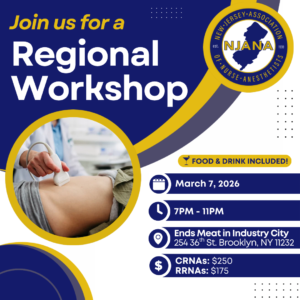
All NJANA members are invited to attend this special 4-hour Regional Workshop to learn the latest block techniques on March 7, 2026. Participants may earn up to 4 Class A CE’s (pending AANA approval). Click here to view the complete program agenda and details.
Date: March 7, 2026
Time: 7 p.m. – 11 p.m.
Location: Ends Meat in Industrial City, 254 36th Street, Brooklyn, NY 11232
NJANA Block Workshop Agenda
6:45 – 7:00pm
Check in
7:00 – 7:30pm
The role of Exparel in Peripheral Nerve Blocks (0.5 CE)
Carly Lubas, BSN, RN, CNOR
Michael Konstantinovsky, DNP, CRNA/APN
Learning Objectives:
- Identify the mechanism of action of liposomal Bupivacaine
- Recognize Exparal dosing parameters for peripheral nerve block injection for a total knee replacement
7:30 – 11:00pm
Upper Extremity Blocks (3.5 CE)
(Interscalene, Supraclavicular, Costoclavicular)
Michael Konstantinovsky, DNP, CRNA/APN
William Bogdon, DNP, CRNA/APN
Jedd Dillman, DNP, CRNA/APN
William McLaughlin, DNP, CRNA/APN
- Identify ultrasound anatomy of the brachial plexus at the interscalene, supraclavicular, and costoclavicular levels
- Describe indications, contraindications, risks, and benefits of upper extremity peripheral nerve blocks
- Integrate patient assessment, positioning, and local anesthetic selection to optimize analgesic outcomes
- Recognize and manage block-related complications in accordance with evidence-based anesthesia practice
Truncal Blocks
(Erector Spinae Plane, Quadratus Lumborum, Rectus Sheath, TAP)
Michael Konstantinovsky, DNP, CRNA/APN
William Bogdon, DNP, CRNA/APN
Jedd Dillman, DNP, CRNA/APN
William McLaughlin, DNP, CRNA/APN
- Identify sonographic landmarks and fascial planes associated with common truncal nerve blocks
- Compare analgesic coverage and clinical applications of ESP, QL, Rectus Sheath, and TAP blocks
- Demonstrate ultrasound-guided needle placement and local anesthetic administration for truncal blocks
- Incorporate truncal blocks into multimodal analgesia plans to enhance postoperative pain control
Lower Extremity Blocks
(Adductor Canal, IPACK, PENG, Genicular)
Michael Konstantinovsky, DNP, CRNA/APN
William Bogdon, DNP, CRNA/APN
Jedd Dillman, DNP, CRNA/APN
William McLaughlin, DNP, CRNA/APN
- Identify ultrasound anatomy relevant to motor-sparing lower extremity regional techniques
- Discuss indications and analgesic benefits of Adductor Canal, IPACK, PENG, and Genicular blocks
- Demonstrate ultrasound-guided techniques to perform lower extremity blocks safely and effectively
- Select appropriate lower extremity blocks based on surgical procedure and patient-specific considerations
Needling Station
Michael Konstantinovsky, DNP, CRNA/APN
William Bogdon, DNP, CRNA/APN
Jedd Dillman, DNP, CRNA/APN
William McLaughlin, DNP, CRNA/APN
- Demonstrate proper ultrasound probe handling and needle visualization techniques
- Perform in-plane and out-of-plane needling using ultrasound simulation models
- Maintain continuous visualization of the needle tip to enhance procedural safety
- Translate needling skills into safe clinical practice within the CRNA scope of practice